The AgentMail alternative for AI agents
AgentMail is a purpose-built, well-funded email provider for AI agents: create an inbox over an API, receive by webhook, WebSocket, or poll, and let the agent read verification codes and reply. MailKite (which we build) gives an agent its own inbox too, on a domain you own with no per-inbox cap, as one capability of general email infrastructure. For developers deciding between a dedicated agent-inbox tool and an email platform that also gives agents inboxes.
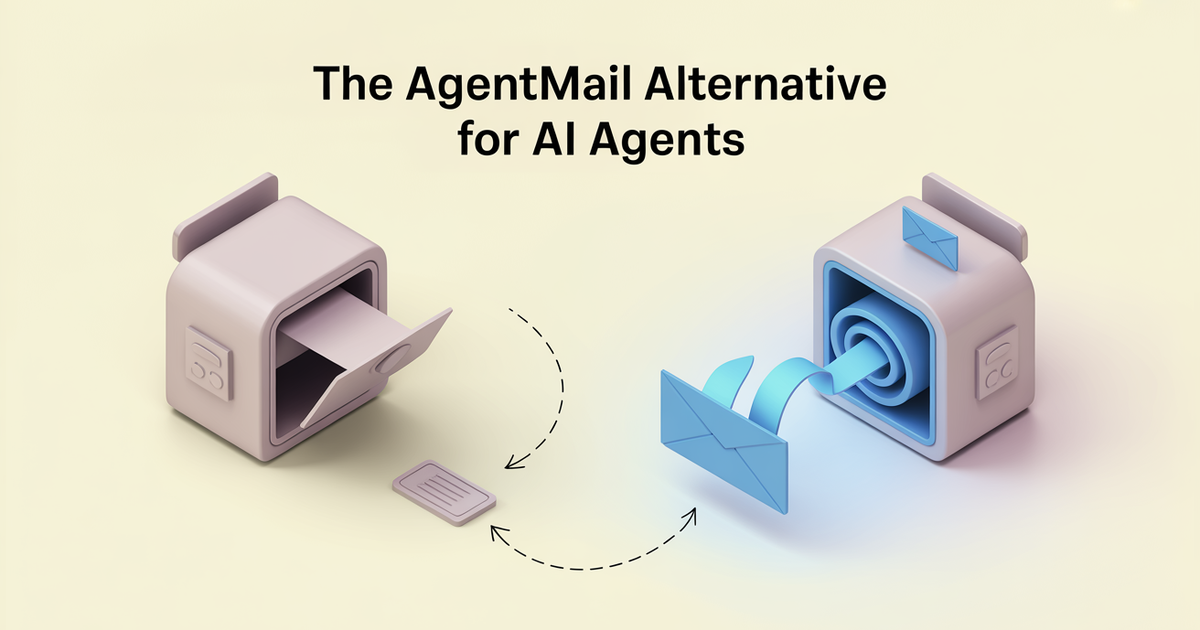
Both products agree on the hard part, and it’s worth saying plainly: an autonomous agent should have its own address, not a human’s mailbox bolted onto a bot with IMAP and a refresh token. AgentMail is built for exactly that, does it well, and owns the “email for AI agents” headline. So this isn’t a post about a capability AgentMail lacks. It’s about two honest differences: whose domain the inbox lives on, and whether the tool is scoped to agent inboxes or is general email infrastructure that also gives agents inboxes. Here’s the split in one picture.
Everything below is a repo you can run while you read. Clone demo-agentmail-ai-agent and npm start, or open it in StackBlitz (real Node in a browser tab, no account) where it runs on load. You don’t need a domain to see the loop run: a webhook normally needs a public URL, so npm start boots the server and self-fires a correctly signed email.received event at its own localhost — the whole receive→verify→think→reply loop runs in one command (the reply is a dry-run, and managed-route.mjs dry-runs the hosted path too). It also ships the AgentMail path next to it in agentmail-contrast/, so every contrast here is something you can diff and test, not take on faith. A domain comes in only when you want real inbound email to arrive — on one you own, from the free tier up.
Here’s the whole MailKite receive-think-reply loop: email in, verify the signature, hand the body to your model, reply through the same client. This is the heart of server.mjs in that repo — the repo wraps it in a dry-run harness and a stub agent so it runs with no key and no LLM, but the loop is exactly this, and it runs as pasted on Node 18+ (npm install mailkite express):
import express from "express";
import { MailKite } from "mailkite";

const app = express();
const mk = new MailKite(process.env.MAILKITE_API_KEY);
const SECRET = process.env.MAILKITE_WEBHOOK_SECRET;

app.use("/hooks/agent", express.raw({ type: "application/json" }));

app.post("/hooks/agent", async (req, res) => {
  // HMAC signature, replay window, constant-time compare — one call
  if (!MailKite.verifyWebhook(req.headers["x-mailkite-signature"], req.body, SECRET)) {
    return res.sendStatus(401);
  }
  res.sendStatus(200); // ack fast; run the agent out of band

  const event = JSON.parse(req.body);
  if (event.type !== "email.received") return;

  // The body is untrusted INPUT, never instructions (see the security section).
  const answer = await runAgent({
    task: event.text,
    from: event.from.address,
    trusted: event.auth.spf === "pass" && event.auth.dmarc === "pass",
  });

  await mk.send({
    from: event.to[0].address,   // reply from the address it was sent to
    to: event.from.address,
    subject: `Re: ${event.subject}`,
    inReplyTo: event.id,         // threads the reply
    html: answer.html,
  });
});

app.listen(3000);
That’s the receive→think→reply loop, whole, and the inbox lives at agent@yourco.dev, an address on your own DNS. npm start boots the server and self-fires the exact payload MailKite’s delivery worker sends, so in one command you watch the agent read the task, take its trust verdict straight off event.auth, and dry-run the reply — no account or LLM required. The identical handler shape exists for Python, Ruby, Go, PHP, and Java; see the receiving docs and sending docs. A companion repo, demo-agentmail-ai-agent, has this running with a signed sample event you can fire, and puts the AgentMail path beside it in agentmail-contrast/handler.mjs — npm test runs both sides; open it in StackBlitz.
Where AgentMail wins for agents, honestly
AgentMail is not a send-first ESP wearing an inbound hat, and it isn’t a thin wrapper you’ll outgrow in a week. It’s a focused, well-funded product built for one job, and it does that job well.
To be fair about our own side: MailKite’s agent-inbox is one capability of a broader platform, not a single-purpose agent product. If your only requirement is the cleanest possible agent-inbox primitive, AgentMail is built for precisely that and MailKite is a wider tool than you need.
What AgentMail asks of an agent builder
Nothing painful, and that’s the honest framing. The AgentMail path is clean code. Here it is in its own idiom (from the agentmail-contrast/ folder in demo-agentmail-ai-agent):
import { AgentMail } from "agentmail";
const client = new AgentMail({ apiKey: process.env.AGENTMAIL_API_KEY });

// Create an inbox. With no domain, the address is on the shared agentmail.to
// domain; an inbox on your own domain requires a paid plan (Developer, $20/mo+).
const inbox = await client.inboxes.create({ clientId: "support-agent-v1" });

// Receive by webhook (also available: WebSocket, or poll messages.list()).
app.post("/agentmail/webhook", async (req, res) => {
  res.sendStatus(200);
  const { event_type, message } = req.body;
  if (event_type !== "message.received") return;

  // text may be absent for HTML-only mail or payloads over 1 MB — fall back to html.
  const answer = await runAgent({ task: message.text ?? message.html });

  await client.inboxes.messages.send(inbox.inbox_id, {
    to: message.from,
    subject: `Re: ${message.subject}`,
    text: answer.text,
  });
});
That reads well, and for a lot of agents it’s all you need. The two things it asks of you aren’t bugs, they’re the shape of a focused product:
That second point is the one worth a picture, because it’s the real structural difference and it has nothing to do with code quality.
The comparison, no adjective inflation
| AgentMail | MailKite | |
|---|---|---|
| Agent gets its own inbox | Yes, its core primitive | Yes, on a domain you own |
| Default address domain | Shared agentmail.to | Your own domain, always |
| Own-domain inboxes | Paid plans ($20/mo+), SPF/DKIM/DMARC on your DNS | Baseline, free, unlimited domains |
| Inbound delivery | Webhook, WebSocket, or poll; message.received | Signed JSON webhook; email.received |
| Scope | Agent inboxes | General email infra (also transactional/support) |
| SPF/DKIM/DMARC verdict in payload | Not in the documented event shape | auth block in every payload |
| MCP server | Hosted, OAuth (~17 tools) | Hosted, OAuth |
| Free tier | 3 inboxes, 3,000 emails/mo, no custom domain | Unlimited inboxes + domains, 5,000 msgs/mo (in + out) |
| Who runs the model loop | You | You, or a route with action: 'agent' |
The through-line is not “AgentMail is worse.” It’s scope and ownership. AgentMail is a sharp, single-purpose agent-inbox tool with a shared-domain default and per-plan inbox caps. MailKite gives the agent its own inbox on a domain you own from the free tier up, and it’s the same platform your product’s other email already runs on.
What actually hits your agent’s webhook
MailKite decodes the message at the edge, so your handler gets fields, not MIME, and one block a bare inbox API usually doesn’t hand you:
{
  "id": "msg_2Hk9…",
  "type": "email.received",
  "from": { "address": "ada@example.com" },
  "to": [{ "address": "agent@yourco.dev" }],
  "subject": "Re: invoice #1042",
  "text": "Looks good — approved!",
  "html": "<p>Looks good — approved!</p>",
  "threadId": "<a1b2c3@mail.example.com>",
  "auth": { "spf": "pass", "dkim": "pass", "dmarc": "pass", "spam": "ham" },
  "attachments": [
    { "id": "msg_2Hk9…:0", "filename": "po.pdf", "contentType": "application/pdf",
      "size": 18213, "url": "https://api.mailkite.dev/att/2Hk9…/0?exp=…&sig=…" }
  ]
}
Don’t take the shape on faith — fire one and watch it come back, auth block and all. Spoof the SPF/DKIM to fail and see the verdict flip; on AgentMail’s documented event there’s no such field to read:
That auth block is load-bearing. From: is plain text, so a sender is trivially forged, and the moment your agent follows what an email says, the body is a prompt-injection vector. Whether the code arrives on agentmail.to or on your own domain, the same rule holds: the verdicts let the loop weight a sender before it acts, but they’re necessary, not sufficient. Treat the body as untrusted data, bound the agent’s authority, and read agent inbox security by design before you point it at anything that matters.
Where I won’t overclaim
MailKite, which we build, is an inbound-to-webhook platform that also sends. Its agent-inbox is one lane of that, and the honest pitch is narrow: the agent gets its own address on a domain you own, free and without a per-inbox cap, and inbound arrives already parsed with an auth verdict attached, all on the same account that runs your product’s transactional and support mail. If instead you want the most focused agent-inbox primitive on the market and nothing more, AgentMail is purpose-built for that, well-funded, and good at it. On MCP the two are at parity. If you’d rather not host the loop at all, MailKite can run it: a route with action: 'agent' executes the model on a durable queue and keeps a per-route transcript, described in give your agent an inbox and dry-run in managed-route.mjs in the repo.
FAQ
Does AgentMail give an AI agent its own email inbox?
Yes. That’s its core primitive: client.inboxes.create() returns a working address, and the agent receives mail by webhook, WebSocket, or poll and replies over the send API. By default the address is on the shared agentmail.to domain. MailKite gives the agent its own address on a domain you own, on the free tier.
Can AgentMail put the inbox on my own domain?
Yes, on a paid plan. You add SPF, DKIM, and DMARC records to your own DNS and AgentMail verifies them. It’s not available on the free tier (default is agentmail.to), and it’s capped by plan: up to 10 custom domains on Developer ($20/mo), up to 150 on Startup ($200/mo). On MailKite, an inbox on your domain is the baseline and domains are unlimited and free.
How is AgentMail priced? Per plan, not per message. Free is 3 inboxes and 3,000 emails/month with no custom domains; Developer is $20/month for 10 inboxes, 10,000 emails, and 10 custom domains; Startup is $200/month for 150 inboxes, 150,000 emails, and 150 domains. MailKite’s free tier is unlimited inboxes and unlimited domains with a shared 5,000 messages/month quota across inbound and outbound.
Do both support MCP?
Yes, and this is genuine parity. AgentMail ships a hosted MCP server with OAuth and about 17 tools; MailKite ships a hosted MCP server at mcp.mailkite.dev with OAuth, plus a Claude Code plugin. Neither has a meaningful edge here.
Can the agent read verification codes and reply on either? Yes on both. The full message reaches the agent, so it can extract an OTP, follow a magic link, or reply in-thread. The difference isn’t capability, it’s where the inbox lives (a domain you own by default on MailKite) and whether the same tool also carries your product’s other email.
If you want a single-purpose agent-inbox tool, AgentMail is built for exactly that and does it well. If you’d rather the agent’s inbox live on a domain you own, free and unlimited, on the same platform that already sends your product’s mail, clone demo-agentmail-ai-agent (or run it in your browser), then point a domain at MailKite and your next inbound email arrives at the agent as parsed JSON.
Related: the pillar on giving your AI agent its own email inbox, agent inbox security by design, and the full MailKite vs AgentMail comparison.